Defining Music Therapy: What is it, and How Does it Work?
Welcome to the start of the official Magnolia Melodies Music Therapy blog! Here we will be publishing informational articles on music therapy, resources for new professionals, and more! For our first post, we will be diving into what Music Therapy is as a practice and a profession.
Defining Music Therapy
According to the American Music Therapy Association (AMTA), the official definition of Music Therapy is: “The clinical and evidence-based use of music interventions to accomplish individualized goals within a therapeutic relationship by a credentialed professional who has completed an approved music therapy program.”
That’s quite a mouthful! Let’s break it down a bit. Music Therapy is ‘clinical and evidence-based.’ It is based upon countless hours of research conducted on our relationship with music, and the effect music has on our brain. It is a practice based upon what we have gathered from scientific research. There are even dedicated scientific journals exploring the benefits of Music Therapy such as The Journal of Music Therapy, and Music Therapy Perspectives.
Music Therapy uses ‘music interventions to accomplish individualized goals.’ Much like any other therapeutic profession, it is used to help clients achieve their physical, cognitive, or emotional goals. Music itself is the modality that helps a client reach their goals, and the methods that it is used with are tailored to meet each specific client’s needs. ‘
It is important to mention that the goals worked on in Music Therapy are nonmusical. To an outsider, a Music Therapy session can look like having fun singing with clients, learning how to play instruments, or dancing. In actuality, the session is designed to target goals in areas such as socialization, communication, movement, and more.
Music Therapy is practiced ‘within a therapeutic relationship by a credentialed professional.’ Music Therapists have to be board-certified by the Certification Board of Music Therapists (CBMT) to legally practice Music Therapy in the United States. To gain this credential, they are required to hold a Bachelor's or Master’s degree in Music Therapy from an AMTA-approved program to gain competencies in musical skills as well as clinical skills.
During their degree, they must complete 1200 hours of clinical training, 1000 of which must come from an on-site supervised internship. They then complete a national board certification exam to earn their MT-BC (Music Therapist - Board Certified). To continue to hold their certification, Music Therapists must also complete continuing education credits every five years.
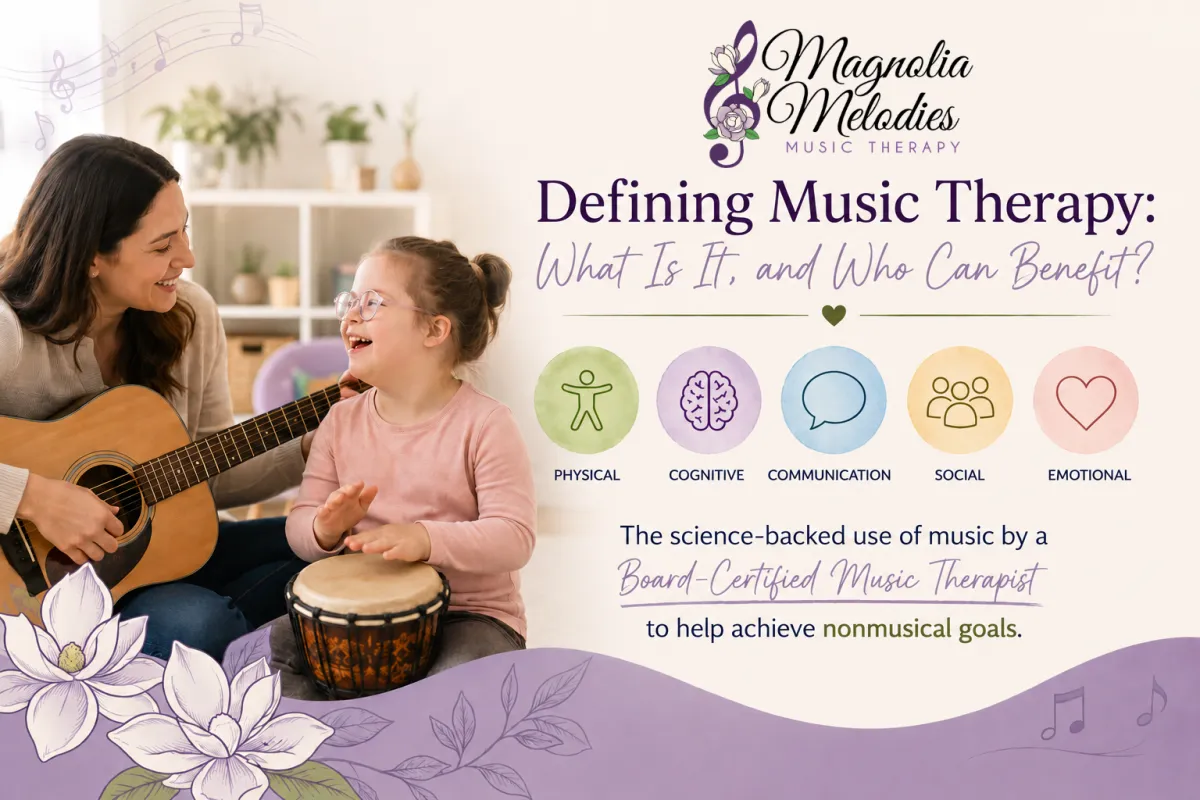
To summarize: Music Therapy is the science-backed use of music by a Board-Certified Music Therapist to help achieve nonmusical goals.
What Do We Work On?
Music is a unique human phenomenon in that it accesses all different parts of our brain at the same time. It contains many different elements including tempo, rhythm, melody, and volume that have different effects on us. Due to the uniqueness of how music affects our brain, Music Therapy can be used to work on several domains:
Physical
Music Therapy can be used to work on physical goals such as controlled gross and fine motor movements, increasing range of motion, hand-eye coordination, and increasing steadiness of gait. A Music Therapist may use specific instruments or movements to a beat to guide clients to increase their ability to reach above their head or strengthen their grasp.
Cognitive
Cognitive goals include skills such as memory, focus, attention span, decision making, and sequencing. An example of cognitive ability includes following multi-step instructions or remembering a grocery list. Music can be used to support sequencing instructions or to increase attention span.
Communication
Communication goals can be verbal or nonverbal depending on the client’s abilities. Clients can work on articulation and oral motor skills through singing or instrument playing, as well as ways to effectively communicate nonverbally through opportunities created by the Music Therapist.
Social
Social goals are common in Music Therapy, working on learning appropriate social cues like saying ‘Hello’ and ‘Goodbye’, taking turns, and working together with others. Music Therapists may create opportunities for clients to work together to play a song, interact in a safe environment, or to take turns playing an instrument.
Emotional
Emotional goals can include identifying how someone is feeling, self-regulation, healthy self-expression and facial affect. Music Therapists can create opportunities through instrument play for clients to express themselves, or discuss song lyrics that a client resonates with.
Who Can Benefit?
Music Therapy is incredibly versatile. This means that it can be used with a wide variety of diagnoses. In fact, you can find Music Therapists working with any and all populations across the lifespan! From schools, day programs, senior centers, memory care facilities, psychiatric hospitals, even the NICU with infants only a few hours old!
Music Therapy sessions can be held in a group setting, or 1-to-1 with a specific client. You don’t have to be a musician to benefit from music therapy either. Music Therapy sessions are tailored towards a group or client’s specific needs.
The Magnolia Melodies team provides Music Therapy services across the lifespan! Our Music Therapists travel to provide sessions in behavioral health at schools or facilities, day programs for adults with disabilities, drug and alcohol recovery programs, and senior care with groups ranging from memory care to skilled nursing, to assisted living.
Music Therapy can be beneficial for many people! We hope this article helped to shed some light on how it can be used. Stay tuned for more posts in the future!
Sources to Explore:
https://www.musictherapy.org/about/musictherapy/
